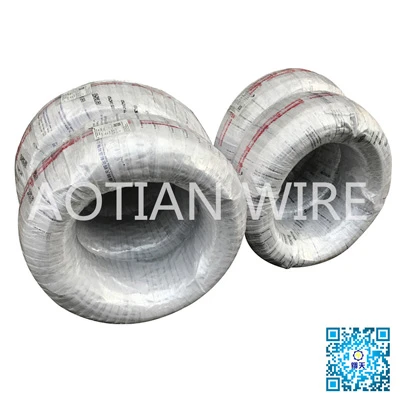

What changes will the galvanized steel wire and iron wire have? It is not easy to be corroded! But do you know how it is done?
The ingredients in steel are iron and carbon. Steel wire will rust when exposed to moist air for a long time, and zinc will form a dense zinc oxide film in the air. This dense oxide film can isolate the metal inside and the air outside, thereby protecting the metal inside and extending it. The life span of the steel wire. It is a chemical method. In addition, it is common in life to coat steel products with paint. This is done to isolate steel from air and prevent moisture from being oxidized. This is a method of physical protection.
It is the same with iron wire. It is galvanized to protect the iron wire. Iron is easily corroded in the air, including oxygen absorption corrosion or hydrogen evolution corrosion. After adding zinc, iron and zinc will form a galvanic cell, because zinc is more reducible than iron. In the modified galvanic cell, zinc acts as a negative and loses electrons and is oxidized. Iron acts as a positive and electrons flow from negative to positive. And the iron is protected from being oxidized, and the life of the iron wire is prolonged.
Zinc plating has excellent resistance to atmospheric corrosion, and a protective film is easily formed on the surface at room temperature. Therefore, zinc is widely used in the galvanizing industry. It is mainly used for the surface coating of steel and steel structural parts (such as galvanized sheet), and is widely used in industries such as automobiles, construction, ships, and light industry. The use of zinc-containing paint is another method of coating; for objects that are in continuous contact with water, such as large steel components used in ships, bridges and offshore oil and gas derricks, they only need to be connected to large zinc blocks. It is protected, but the zinc block needs to be replaced regularly.