
What Is Screw
A screw is an externally helical threaded fastener capable of being tightened or released by a twisting force (torque) to the head. The most common uses of screws are to hold objects together and there are many forms for a variety of materials. Screws might be inserted into holes in assembled parts or a screw may form its own thread. Most screws are tightened by clockwise rotation, which is called a right-hand thread. Screws with a left-hand thread are used in exceptional cases, such as where the screw will be subject to counterclockwise torque, which would tend to loosen a right-hand screw.
Advantages of Screw
Extra strength & long-lasting hold
Screws are very strong and are built to last. This is a stark contrast to nails, which may come loose over time. This happens when the materials they connect with begin to expand and shrink over time. Screws are built to resist this problem. Their hold is longer-lasting and stronger.
Rust resistant
Since screws offer a strong and tight bond with their adjoining material, this makes them less susceptible to rusting. The tight hold prevents moisture and contaminant from coming into contact with the screw’ s shaft, thus preserving it for a long-lasting hold. So, even if the head of the screw begins to rust, the shaft will remain intact and hold due to this preservation.
Easy to remove
When it comes to removal, there is no fastener that is easier than screws. Of course, you can remove nails and staples. However, you likely need a special tool to get them out. With a screw, they back out of their slots with the same tool that drove them in. So you don’ t need to go looking for a different tool and can save that time working.
Reuse screws
Due to the strength and longevity of screws, you can reuse them more when compared to nails. They seldom bend during the removal, so they can be reused for another application. You can also reinsert them into the same hole without sacrificing strength.
-
![DIN7505 Drywall Screw]() DIN7505 Drywall ScrewAoTian Steel Wire are a professional manufacturer for different kinds of fastener products. If you want to know Black Phosphated Bugle Head DIN7505 Drywall Screw Factory Price,please contact us...read more
DIN7505 Drywall ScrewAoTian Steel Wire are a professional manufacturer for different kinds of fastener products. If you want to know Black Phosphated Bugle Head DIN7505 Drywall Screw Factory Price,please contact us...read more -
![Drywall Screws/Nails]() Drywall Screws/NailsCarbon Steel Wire Rod High Tensile Strength Professional Supplier Coils tandard Screws With Excellent Quality,AoTian Steel Wire have a strict quality system, the raw materials of each order will...read more
Drywall Screws/NailsCarbon Steel Wire Rod High Tensile Strength Professional Supplier Coils tandard Screws With Excellent Quality,AoTian Steel Wire have a strict quality system, the raw materials of each order will...read more -
![Truss Head Screw]() Truss Head ScrewWe supply Truss Head Screw for you, we are the manufacturer, welcome to contact us for more information.read more
Truss Head ScrewWe supply Truss Head Screw for you, we are the manufacturer, welcome to contact us for more information.read more -
![Welding Screws]() Welding ScrewsWe supply Welding Screws for you, we are the manufacturer, welcome to contact us for more information. Self Clinching Studs Brass Copper Plated Stud Welding Screws and Rodsread more
Welding ScrewsWe supply Welding Screws for you, we are the manufacturer, welcome to contact us for more information. Self Clinching Studs Brass Copper Plated Stud Welding Screws and Rodsread more -
![C1022 Hardened Black Zinc Phosphated Drywall Screws]() C1022 Hardened Black Zinc Phosphated Drywall ScrewsWe offer you C1022 Hardened Black Zinc Phosphated Drywall Screws, we are the manufacturer.read more
C1022 Hardened Black Zinc Phosphated Drywall ScrewsWe offer you C1022 Hardened Black Zinc Phosphated Drywall Screws, we are the manufacturer.read more -
![Drywall Screw Yellow Zinc Plated]() Drywall Screw Yellow Zinc PlatedBugle Head Phillips Drive Drywall Screw Yellow Zinc Plated Hardenread more
Drywall Screw Yellow Zinc PlatedBugle Head Phillips Drive Drywall Screw Yellow Zinc Plated Hardenread more -
![Black Drywall Screw]() Black Drywall ScrewBlack Carbon Steel M3.5 Phillips Bugle Head Phosphated Self-tapping Coarse Thread Drywall Screw,If you want Black Phosphated Bugle Head DIN7505 Drywall Screw Factory Price,please contact AoTian...read more
Black Drywall ScrewBlack Carbon Steel M3.5 Phillips Bugle Head Phosphated Self-tapping Coarse Thread Drywall Screw,If you want Black Phosphated Bugle Head DIN7505 Drywall Screw Factory Price,please contact AoTian...read more -
![Self Drilling Screws DIN7504]() Self Drilling Screws DIN7504Stainless Steel Countersunk Phillips Head Self Drilling Screws DIN7504read more
Self Drilling Screws DIN7504Stainless Steel Countersunk Phillips Head Self Drilling Screws DIN7504read more -
![Core-Pulling Blind Rivets]() Core-Pulling Blind RivetsM4 304 Ss Stainless Steel Aluminum Round Head machine Pop Core-Pulling Blind Rivetsread more
Core-Pulling Blind RivetsM4 304 Ss Stainless Steel Aluminum Round Head machine Pop Core-Pulling Blind Rivetsread more -
![Iron Steel Wire Nail]()
-
![Stainless Steel Self Tapping Screw]()
-
![DryWall Nails]()


Why Choose Us
1.Professional team: We insist offering first-class prodcuts and best service to customers around the world for 20 years.
2.Safety assurance: We have obtained ISO9001and IATF16949 Certificates. And also get SGS along with TCT product certificates.
3.Production market: Our products not only share big market in China but also export to many other countries for more than 10 years, such as Europe, Middle East and Central Asia.
4.Complete after-sale service: Our management idea is profession, learning, innovation and transcendence. We are ready to provide products of high quality and the best service for our customers.
Types of Screw
Wood screw
Early wood screws were made by hand, with a series of files, chisels, and other cutting tools, and these can be spotted easily by noting the irregular spacing and shape of the threads, as well as file marks remaining on the head of the screw and in the area between threads. Many of these screws had a blunt end, completely lacking the sharp tapered point on nearly all modern wood screws. Screws made with these tools have rounded valleys with sharp and rough threads.Once screw turning machines were in common use, most commercially available wood screws were produced with this method. These cut wood screws are almost invariably tapered, and even when the tapered shank is not obvious, they can be discerned because the threads do not extend past the diameter of the shank. Such screws are best installed after drilling a pilot hole with a tapered drill bit. The majority of modern wood screws, except for those made of brass, are formed on thread rolling machines. These screws have a constant diameter and threads with a larger diameter than the shank and are stronger because the rolling process does not cut the grain of the metal.
Machine screw
A machine screw is generally a smaller fastener (less than 1⁄4 inch (6.35 mm) in diameter) threaded the entire length of its shank that usually has a recessed drive type. Machine screws are also made with socket heads , in which case they may be referred to as socket head machine screws.
Hex cap screw
Renaming finished hex bolts to hex cap screw – a term that had existed in common usage long before, but was now also being codified as an official name for the asme b18 standard. Lug bolt and head bolts are other terms that refer to fasteners that are designed to be threaded into a tapped hole that is in part of the assembly and so based on the machinery's handbook distinction they would be screws. Here common terms are at variance with machinery's handbook distinction.
Lag screw
Lag screws are used to lag together lumber framing, to lag machinery feet to wood floors, and for other heavy carpentry applications. These fasteners are "screws" according to the machinery's handbook criteria, and the obsolescent term "lag bolt" has been replaced by "lag screw" in the handbook. Because, like head bolts, they are large, with hex or square heads that require a wrench, socket, or specialized bit to turn.The head is typically an external hex. Metric hex-headed lag screws are covered by din 571. Inch square-headed and hex-headed lag screws are covered by asme b18.2.1. A typical lag screw can range in diameter from 4 to 20 mm or #10 to 1.25 in (4.83 to 31.75 mm), and lengths from 16 to 200 mm or 1⁄4 to 6 in (6.35 to 152.40 mm) or longer, with the coarse threads of a wood-screw or sheet-metal-screw threadform.
Bone screw
Like aerospace and nuclear power, medical involves some of the highest technology for fasteners where performance, longevity, and quality are reflected in the price. Bone screws tend to be made of stainless steel or titanium, and they often have high-end features such as conical threads, multistart threads, cannulation (hollow core), and proprietary screw drive types.
A screw is a type of hardware fastener that attributes its mechanical capabilities to the helical groove that extends around the circumference of the device's shank. These threads provide the friction and traction that serves a screw's purpose: to assemble or position two workpieces in relation to each other. Screws come in many varieties. The external threads on the screw can either mate with an internally threaded nut or hole, or cut its way into a soft material. Screws are inserted via torque applied--in a clockwise manner--to the head with a screw drive. Screws are externally threaded fasteners that can be inserted into pretapped holes or that can perforate a material and create its own internal thread. Screws are fastened by torque applied to the head. This definition is still somewhat ambiguous and is not all-encompassing, but does provide a basis to begin differentiation.
The parts on screws can be identified rather easily. The head is the section of the screw with the largest diameter and the imprint of a screw drive. This also provides a load surface once in use. The shank of the screw contains the threaded section (shoulder screws being an exception) and is responsible for the alignment of the workpieces and screw. Finally, the end of the screw that does not have the head is known as a chamfer. This tapered end allows the screw to be inserted into pieces with less resistance than the screw's full diameter. Even on machine screws, there will be a beveled edge to assist penetration.
Aluminum screws are light, resistant to oxidation, thermal and electrical conducive, and easy to manufacture. Brass screws are strong, conductive, and corrosion resistant, with low magnetic permeability. Copper alloy screws have good load capacity, wear resistance, and are suitable for use near magnets. Molybdenum screws have a very high melting point and are exceptionally strong. Plastic screws are inexpensive and corrosion resistant for light loads. They are common for applications near water, such as pools. Steel screws are produced of strong, carbonated iron. Uncoated steel is vulnerable to corrosion. Hardened steel screws on hardening methods to produce a stronger, but more brittle, version of steel. Stainless steel screws are chemical and corrosion resistant with an appealing finish. They cannot be hardened like carbon steel. Screws consisting of superalloys exhibit good mechanical strength, surface stability, corrosion resistance, and resistant to creep at high temperatures. Titanium screws are hard and strong, light, and corrosion resistant. When alloyed with other metals, it increases strength and durability.
Finishes applied to the base metal of the screw enhance the durability and corrosion resistance of the material. Black oxide finishes do not enlarge the dimensions of the screw and is a processed black rust. It is mostly used for aesthetic purposes. Chrome coating is a bright, reflective finish that is decorative and very durable. It is applied via electropating. Zinc plated coatings act as a sacrificial anode, protecting the underlying metal. It is applied as a fine white dust. Other coatings like galvanization and phosphating are common for particular types of hardware, like screws meant for fence or window applications. The chamfer angle on the underside of the head, known as the countersink, mates with a conical recess in the workpiece so the head may rest flush with the workpiece surface. ISO metric countersinks are usually 90°, while imperial screws typically have a countersink of 82°. Manufacturers produce screws in both imperial and metric units, and due to their explicit correspondence with nuts and pretapped holes, the units cannot be mixed. Furthermore, screws are produced with fine or coarse threads, which are a designation of the screw's thread pitch--not the quality of the product. Coarse-thread screws are less susceptible to galling, thread crossing, and seizing, while fine-thread screws are less likely to loosen from jostling, and are more easily tapped and adjusted. For screws that cut their own threads in a soft material, there is no need to determine the thread type.
The Key Parts of a Screw
1.Head
The head of a screw is its topmost part and serves as the primary contact point for tools during installation. There are many different types of screw heads and drive types. You can also categorize screw heads by being countersunk or non-countersunk. Countersunk is when the head rests evenly with the material surface after installation. Non-countersunk is when the head protrudes the material surface after installation, leaving the head exposed. Regardless of which you select, your choice of screw head is critical, as it determines the tool required for installation/removal and impacts efficiency, torque transmission, and installation/removal accessibility.
2.Shank
The shank refers to the main body of the screw, which connects the head to the tip. It has a pivotal role in determining the screw’ s load-bearing capacity and resistance to shear forces. The shank’ s length and diameter vary depending on the application, ensuring optimal strength while considering space constraints. Additionally, the shank may feature unthreaded portions, known as the shoulder or body, for specialized applications.
3.Threads
Threads are the distinctive ridges spiraling around the shank of a screw, responsible for creating a strong and secure connection. They engage with the mating surface, generating friction and preventing the screw from loosening under load. There are various standards used to define thread characteristics. They each have different thicknesses — from fine to coarse — and, therefore, different performance capabilities.
4.Drive
The drive is what determines which type of screwdriver or fastening tool must be used to install and remove a screw. Internal drives require a tool that inserts into the screw head, like a screwdriver. Phillips, slotted, and socket heads are some internal drive examples. Here’s a photo of a wood screw with one. External drives require a tool that wraps around the screw head, like a wrench. Hex, hex flange, and square heads are some external drive examples.
5.Tip
Located at the opposite end of the head, the tip, or point, initiates contact with the material being fastened. Different point designs cater to specific applications. For instance, self-drilling tips enable screws to penetrate metal without the need for pre-drilling, saving time and effort. Self-tapping tips create their own threads in materials like wood or plastic. Sharp tips are ideal for precise placement in delicate applications. Some screws don’ t have tips or points but rather a blunt end. These are more common in the manufacturing space and are generally used with a pre-tapped hole.
How Many Distinctions Between Screws and Bolts Are There?
One general distinction between a screw and a bolt is that bolts are driven from the outside of the head, whereas screws are operated by a central drive. This is primarily due to the fact that greater torque can be exerted on the outside edges of a larger head diameter, as a wider head provides a greater distance from the axis of rotation. One problem with this definition is that it is sometimes difficult to define components which incorporate features of both type, such as slotted hexagon bolts, which have both a drive, and an externally driven head - in these situations, technical distinction and identification of the dominant characteristic becomes somewhat arbitrary.
Another key difference is that bolts are generally used in conjunction with unthreaded holes and secured using nuts, but screws are fastened directly into a threaded hole.
A bolt has historically referred to a smooth, sliding shaft, so it is not unreasonable to see how some users define a bolt as being partially threaded. Thread length is a relatively rare, but not unheard of distinction between bolts and screws - some users argue that a fastener which is fully threaded is classed as a screw, whereas any fastener with an unthreaded shank is a bolt. Examples of this are commonly found with countersunk screws, of which the partially threaded versions are referred to as bolts by some users. Another example would be partially and fully threaded hexagon bolts, with the latter being occasionally known as a set screw. This distinction between screws and bolts is not particularly popular, and is easily contradicted, but is still encountered on occasion.
Products designated as screws, with the exception of lag screws, are required to have a chamfered point. As imperial screws are slowly phased out of modern engineering projects, this definition is becoming less and less prevalent. This standard doesn’ t necessarily define what makes a screw a screw, but it does define that anything with a completely flat tip is either a bolt, or out-of-spec. The problem with using this distinction is that it must be identified just how much of a taper qualifies as a taper. Almost all modern fasteners have a slight taper caused by deburring, which is also essential for ensuring smooth location. Products such as machine screws, which have a flat tip by design, are commonly chamfered to the same degree as an equivalent bolt.
Although very much an oversimplified view, bolts are often manufactured in larger sizes than screws, as a larger size lends itself well to their bulkier, more heavy-duty manufacturing. For this reason, some users would simply know a small fastener as a screw, and a larger fastener as a bolt. Despite this use, size does not generally factor into the distinction between bolts and screws, and is more a byproduct of their design.
The Applications of Screws
Automotive industry
The automotive industry is one of the largest users of screw. Every car, truck, or motorcycle has thousands of screw that hold different parts together. These fasteners are used to secure body panels, engine components, and other vital parts. They must be strong, durable, and resistant to vibration, heat, and corrosion. The most common types of screw used in the automotive industry include hex bolts, socket head cap screws, threaded rods, and washers.
Construction industry
Screw play a crucial role in the construction industry. They are used to connect different materials and components, such as steel, wood, concrete, and masonry. These fasteners must be able to withstand heavy loads, weather conditions, and structural stress. The most common types of screw used in the construction industry include anchor bolts, lag bolts, expansion bolts, and self-tapping screws.
Aerospace industry
The aerospace industry requires high-quality and high-strength screw that can withstand extreme conditions, such as high temperatures, pressure, and vibration. These fasteners must also be lightweight to minimize the overall weight of the aircraft. The most common types of screw used in the aerospace industry include titanium bolts, aerospace nuts, and rivets.
Electronics industry
The electronics industry is another significant user of screw. These fasteners are used to hold electronic components and circuit boards together. They must be small, precise, and easy to install. The most common types of screw used in the electronics industry include pcb screws, standoffs, and spacers.
Medical industry
The medical industry requires specialized screw that are biocompatible and non-corrosive. These fasteners are used in medical devices, implants, and surgical instruments. They must be made from materials that can withstand sterilization and corrosion resistance. The most common types of screw used in the medical industry include bone screws, spinal screws, and orthopedic screws.
Marine industry
The marine industry requires screw that can withstand exposure to saltwater, moisture, and corrosion. These fasteners are used to hold different components of boats, ships, and offshore structures together. They must be made from high-quality stainless steel or other corrosion-resistant materials. The most common types of screw used in the marine industry include marine grade bolts, nuts, and washers.
Our Factory
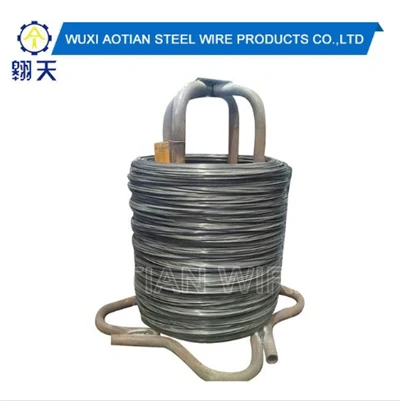
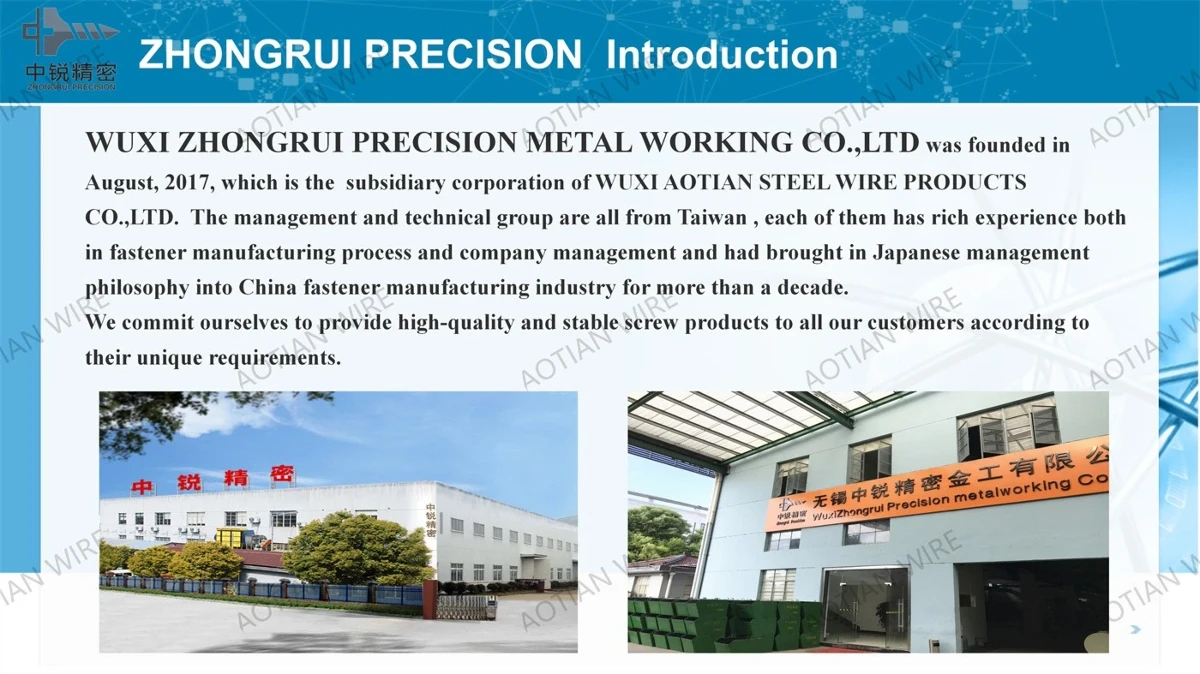
Wuxi AoTian Steel Wire Products Co., Ltd (original: Wuxi HuaTian Standard Piece and Wire Drawing Co., Ltd) was founded in 2000. Our company specializes in manufacturing advanced steel wire products, such as carbon steel spheroidized wire, alloy steel spheroidized wire and rivet wire for cold heading and so on. Our production capacity can reach 40,000 ton per year. Our products are widely used in making auto, aerospace and ship fasteners, precisional electronic screws, high strength bolts and nuts and self-drilling screws and other irregular parts and so on.



Our certificate


FAQ
As one of the leading screw manufacturers and suppliers in China, we warmly welcome you to wholesale screw for sale here from our factory. All customized products made in China are with high quality and low price. For free sample, contact us now.
-
![SAE1008 For Screws And Rivets]() SAE1008 For Screws And RivetsCold-drawn low-carbon steel wire is made from ordinary carbon steel hot-rolled coils with a diameter of 6.5 or 8 mm,...read more
SAE1008 For Screws And RivetsCold-drawn low-carbon steel wire is made from ordinary carbon steel hot-rolled coils with a diameter of 6.5 or 8 mm,...read more -
![Cold Drawn Wire CH1T]() Cold Drawn Wire CH1TCH1T is a kind of alloy structural steel, which has suitable hardenability, and after suitable metal heat treatment,...read more
Cold Drawn Wire CH1TCH1T is a kind of alloy structural steel, which has suitable hardenability, and after suitable metal heat treatment,...read more -
![Steel Wire SCR420]() Steel Wire SCR420cold heading steel wire SCR420 with SAIP condition, mainly used for producing screws.read more
Steel Wire SCR420cold heading steel wire SCR420 with SAIP condition, mainly used for producing screws.read more -
![Wire Rod SWRCH22A]() Wire Rod SWRCH22ALow Carbon Quality 6.5mm SWRCH22A Steel Wire Rod With Good Price,The wire rod has a wide range of uses. In addition...read more
Wire Rod SWRCH22ALow Carbon Quality 6.5mm SWRCH22A Steel Wire Rod With Good Price,The wire rod has a wide range of uses. In addition...read more